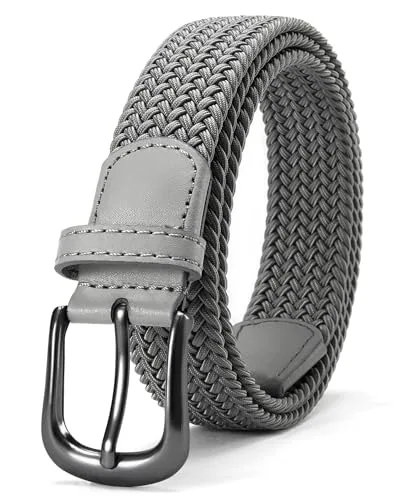
Braided
Elastic Braided Boys' Belt (Grey, 22″ waist)
elastic weave
4.8 out of 5 · 251 ratings$7.99
Children abandon belts for one reason, and it is not the pattern. Here is what makes the difference, and what the federal definition of a children's product actually covers.

This piece quotes public CPSC guidance about how children's products are defined and certified. It describes the rule, not a certification of any particular belt: the label on a specific product and the page its maker publishes for it are where that maker states what it complies with.
Ask a parent why the belt stopped being worn and the answer is almost never that it broke. It is that the child could not do it up without help, and a garment that needs an adult at the door every morning stops being used by about the second week.
Everything else in this piece follows from that one observation.
A pin buckle needs three things at once: the strap held taut with one hand, the pin aimed at a hole with the other, and enough force through the fingertips to push it through stiff leather. Small hands are short on all three.
A click buckle needs the strap pushed in until it stops. There is nothing to aim at, the mechanism does the holding, and the release is a lever under a thumb. It is the difference between a task and a push.
That is the honest case for a ratchet belt on a child, and it is a better case than the one usually made for adults.
Children's waists move faster than anything else about them. A belt bought to fit exactly in September is a belt fastening on its last hole by spring.
A youth ratchet strap is cut once and then adjusts in fifth-of-an-inch steps, which is roughly a year of growth absorbed without anybody noticing. That is the practical reason the youth department here is built on the same mechanism as the adult one rather than on a scaled-down pin belt.
| Department | Belts | Waist covered | Widths | From |
|---|---|---|---|---|
| Ratchet Belts | 65 | 26″ to 52″ | 32 mm, 35 mm, 38 mm | $6.83 |
| Tactical & Work Belts | 38 | 26″ to 48″ | 32 mm, 38 mm | $7.49 |
| Stretch & Webbing Belts | 55 | 26″ to 52″ | 28 mm, 35 mm, 38 mm | $7.99 |
| Reversible Belts | 8 | 32″ to 38″ | 32 mm | $5.99 |
| Dress & Pin Belts | 22 | 32″ to 37″ | 35 mm | $4.99 |
| Boys' Belts | 25 | 16″ to 32″ | 28 mm, 32 mm | $4.99 |
| Straps & Buckles | 18 | 32″ to 42″ | 32 mm, 35 mm, 38 mm, 40 mm | $9.49 |
The narrower widths matter as much as the shorter lengths. Children's trouser loops are cut small, and a 35 mm strap simply will not pass through them.
There is a federal definition, and it is narrower than most people assume.
The law defines a "children's product" as a consumer product designed or intended primarily for children 12 years of age or younger.
Twelve years, not eighteen. A belt sized and marketed for a nine year old is inside that definition. The same belt in an adult size is not, even if a teenager wears it.
The Commission lists the things it weighs when the answer is not obvious: what the maker says the product is for, how it is shown in packaging and advertising, whether consumers commonly recognise it as a children's item, and the published age determination guidelines. Sizing and decoration both count.
Children's products are required to undergo third-party testing and to have a written Children's Product Certificate (CPC) demonstrating compliance.
That is a requirement on the maker, discharged with a document, and it is the reason a children's product page carries statements an adult one does not. What it is not is something a shop can assert on a maker's behalf.
So the useful thing to do as a buyer is to read what the maker publishes for the specific belt rather than a page like this one. What we can tell you here is the size window, the width and the material of every belt in the youth department, and those are on every card.
A child's belt gets sat on, dragged through a school bag and occasionally worn in the rain. Webbing takes all three better than leather does, and it costs less.
The argument for leather on a child is a school uniform that calls for it, and that is a real argument. If the belt is for uniform, the word on the label still matters, and the same federal guide applies to a youth belt as to an adult one.
It is unfair or deceptive to use the unqualified term “leather” or other unqualified terms suggestive of leather to describe industry products unless the industry product so described is composed in all substantial parts of leather.
Which layer of hide it is matters less on a belt that will be outgrown in eighteen months than on one meant to last a decade. Buying genuine leather rather than full-grain for a nine year old is a sensible economy rather than a compromise.
A belt is not something a child asks for. It arrives because a waistband gapes or a school list says so, and it is worn under protest until it either becomes invisible or gets abandoned.
Three things decide which. The first is whether he can work it alone, which is the whole first half of this piece. The second is whether it hurts: a stiff strap folded double at the buckle digs in when he sits on the floor, and a child will not tell you that, he will simply stop wearing it. The third is whether it looks like his own rather than a small version of his father's.
That last one is the reason the youth end of most ranges is not just adult belts scaled down. A narrower strap and a smaller buckle read as proportioned rather than borrowed, and a nine year old notices the difference even if he could not name it.
Uniform lists say black or brown, and occasionally leather. They almost never say a width, and they never say a mechanism.
That leaves more room than parents assume. A black leather ratchet belt in a youth width satisfies every uniform list we have seen, and it solves the fastening problem at the same time. A plain buckle in a dark finish is the safe reading of anything ambiguous.
Where a list does specify, follow it rather than this page. Uniform requirements are set by a school and change without notice, and there is no version of this argument worth having at a gate on a Monday morning.
It works exactly once and then stops working. An adult strap trimmed to a child's waist is still adult width, so it fouls the loops, and the buckle is sized and weighted for a grown-up waistband. It also removes the growth window instead of extending it.
On a punched belt this means fastening on the first hole with half the strap hanging loose, which is the exact configuration a child gives up on. On a ratchet belt it is unnecessary, because the window already is the two sizes ahead.
A belt for a nephew or a godson is the same problem as a belt for an adult, with one number less to work from: you cannot ask a nine year old his waist and expect a useful answer.
A belt in the wrong width is a present that cannot be rescued. A belt in a window that is slightly too generous is a present that gets worn for two years.
Three signals, in the order they usually appear.
If the mechanism is the thing to fix rather than the size, the piece on what size belt you actually take covers measuring in more detail, and it applies to a nine year old exactly as it does to an adult.
Where this came from
U.S. Consumer Product Safety Commission
Children’s Products: business guidance
Federal Trade Commission
16 CFR Part 24, Guides for Select Leather and Imitation Leather Products
Every source above was opened and read on the date shown. Where a page says something we cannot check ourselves, we quote it and name it rather than restating it as our own.
Belts this piece is about
elastic weave
4.8 out of 5 · 251 ratings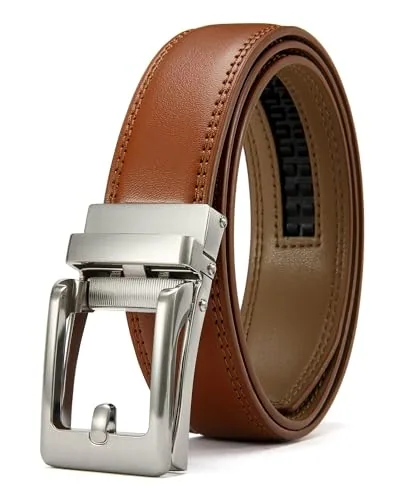
20″ to 24″ waist
4.7 out of 5 · 293 ratings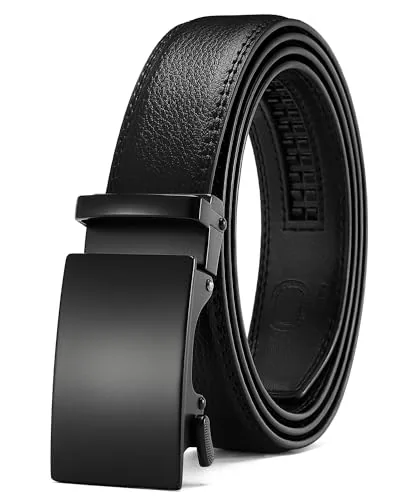
22″ to 26″ waist
4.7 out of 5 · 275 ratings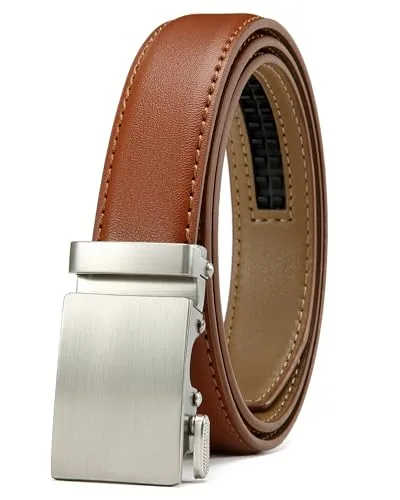
leather
4.7 out of 5 · 214 ratingsKeep reading
Full-grain, top-grain, genuine, bonded. Four words that sound like grades of the same thing and are not.
1,604 words
Two inches, one buckle, and the commonest reason a belt arrives too short.
1,535 words