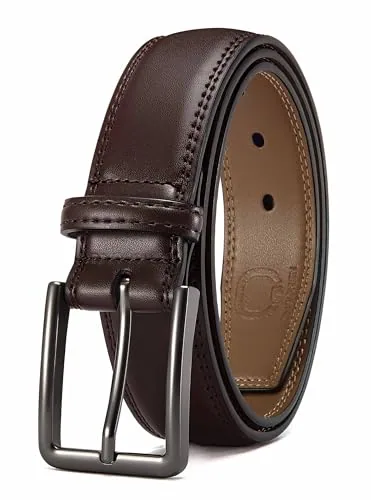
Dress
Leather Dress Belt, 35 mm (Brown)
34″ to 35″ waist
4.6 out of 5 · 1,361 ratings$16.99
There is a federal guide about the word leather, it names belts specifically, and almost nobody who sells belts mentions it. Here is what it actually requires.
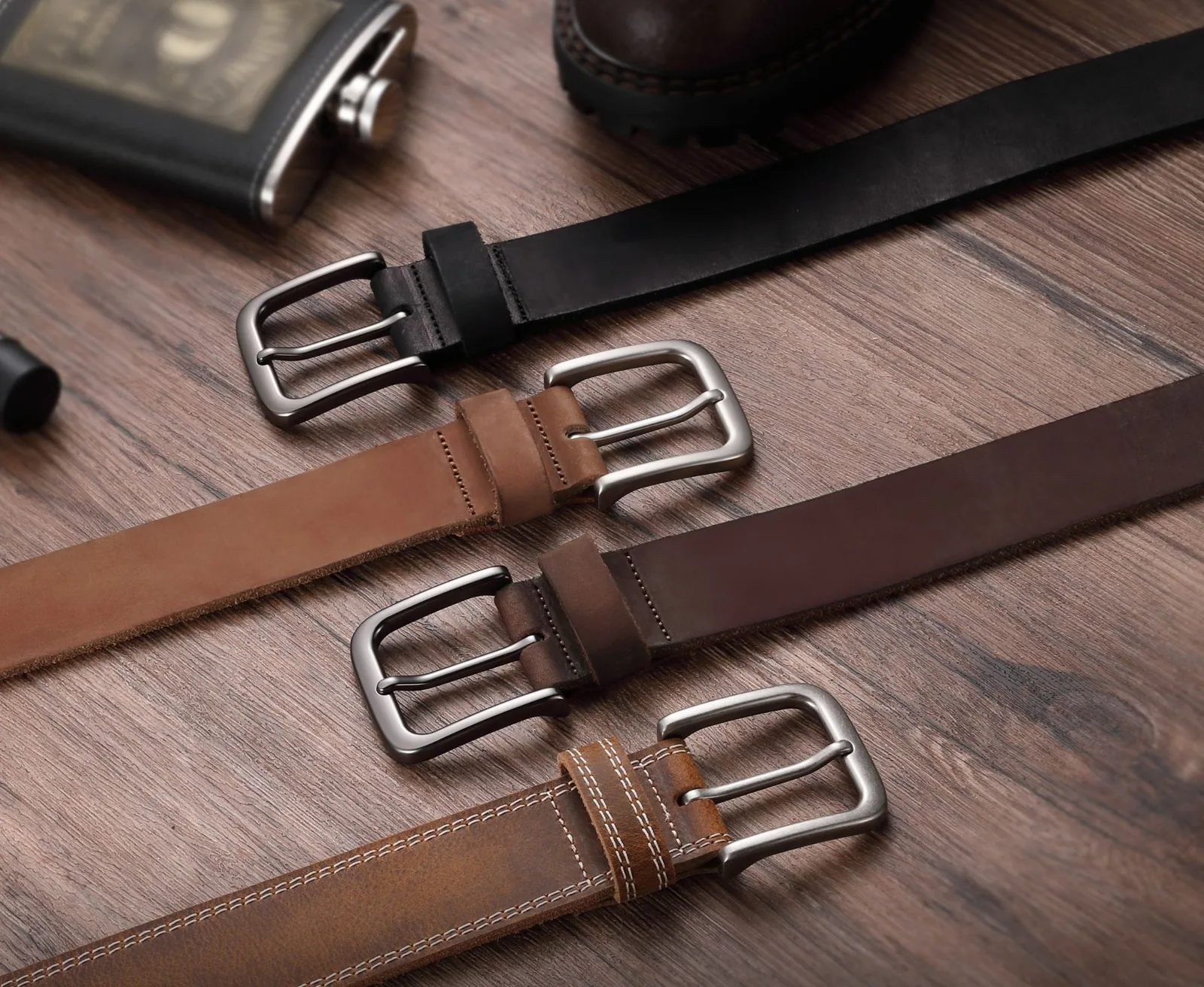
This piece quotes a public FTC guide and explains how to read a belt label against it. The label on a specific belt is the statement its maker is answerable for: where a label and anything here disagree, the label is the document that counts.
Stand in front of a rack of belts and four words are doing all the work: full-grain, top-grain, genuine leather, bonded. They read like a ladder of quality, and three of them are, but not in the order most people assume.
There is also a rule about which of them may be shortened to the plain word leather, and it is worth knowing before you spend anything.
The Federal Trade Commission publishes guides for leather goods. They are not a standard that a product passes or fails. They are the Commission's statement of what it will treat as deceptive. The scope is unusually specific about what counts.
The Guides in this part apply to the manufacture, sale, distribution, marketing, or advertising of all kinds or types of leather or simulated-leather trunks, suitcases, traveling bags, sample cases, instrument cases, brief cases, ring binders, billfolds, wallets, key cases, coin purses, card cases, French purses, dressing cases, stud boxes, tie cases, jewel boxes, travel kits, gadget bags, camera bags, ladies' handbags, shoulder bags, purses, pocketbooks, footwear, belts (when not sold as part of a garment) and similar articles (hereinafter, “industry products”).
Belts, in that list, when they are not sold as part of a garment. A belt sold on its own is inside the guide. A belt that comes threaded through a dress is not, which is an oddity of drafting rather than a difference in the leather.
One line carries most of the weight, and it is worth reading twice.
It is unfair or deceptive to use the unqualified term “leather” or other unqualified terms suggestive of leather to describe industry products unless the industry product so described is composed in all substantial parts of leather.
Two things follow from it. The plain word leather, with nothing attached, is a claim that the substantial parts of the article are hide. And a qualified term, one with a word in front of it, is how a maker describes something that is leather of a particular kind.
That is why a careful card says full-grain leather or top-grain leather rather than leaving the word alone. It is not marketing decoration. The adjective is the part that carries the information.
| On the label | What it describes | How it ages | In our range |
|---|---|---|---|
| Full-grain leather | The outer surface of the hide, unsanded | Darkens and patinates | 8 |
| Top-grain leather | The outer layer, sanded flat and refinished | Stays uniform, wears thinner | none right now |
| Cowhide leather | Names the animal, not the layer | Depends on the layer beneath | none right now |
| Genuine leather | Real hide, layer unstated | Usually a split, cracks at the fold | none right now |
| Leather | Used alone, it claims all substantial parts | Depends entirely on the layer | 93 |
The outer surface of the hide with nothing sanded off it. It carries the marks the animal collected, so no two full-grain straps are the same colour, and it is the layer with the tightest fibre. It darkens rather than wears through.
The same outer layer with the surface corrected: sanded flat and refinished. It looks more uniform than full-grain and it is more uniform, because the variation has been removed. The trade is that the toughest fibres went with it.
The phrase that misleads more people than any other in this trade. It means the article is leather rather than an imitation. It says nothing at all about which layer, and it is usually a lower split of the hide finished to look like the top.
Leather scrap ground up and set in a binder, then embossed with a grain. The guide is direct about how it may be described.
A material in an industry product that contains ground, pulverized, shredded, reconstituted, or bonded leather and thus is not wholly the hide of an animal should not be represented, directly or by implication, as being leather.
Read that against a belt priced at a few pounds and described as leather with no other word attached, and you have the whole reason the guide exists.
Even a correct label leaves out the three things that decide how long a belt lasts, and none of them is the grade of the hide.
So a label is a floor rather than a forecast. It tells you what you are not being sold.
Half of this range is not leather at all: nylon webbing, elastic weave, braided cord. None of them is covered by the leather guide, because none of them pretends to be hide.
They also fail differently, and mostly better. Webbing does not crease at the fold, it frays at the cut end, and a heat-sealed end does not fray at all. For a belt that gets wet, sat on and loaded, webbing outlasts leather of the same price by a wide margin.
The reason to buy leather is what it looks like with a shirt, and that is a perfectly good reason. It is just not a durability argument.
The four words map onto price more tightly than most material ladders do, because the raw hide is genuinely the expensive part.
A bonded strap costs a few pounds because the input is scrap that would otherwise be waste. A split finished as genuine leather costs more because it is real hide, just not the good layer. Top-grain costs more again, and full-grain is the top of the ladder because it comes off the part of the hide with the fewest marks.
What that means at a rack is simple: below a certain price the words cannot all be true at once. A belt that is full-grain, wide, thick and cheap is one of those four claims short, and the label will tell you which if you read the word in front of leather.
Everything above is about the strap. The buckle is metal, and the leather guide has nothing to say about it, which leaves a gap most belt descriptions quietly live in.
Zinc alloy is what most buckles in this price band are, including ours. It is cast rather than machined, so the shapes can be complicated, and it is plated rather than solid in colour. The plating is the part that wears: a matte or brushed finish hides the first scratches, a polished one shows every single one.
A carbon-fibre face is a moulded panel set into a zinc frame, not a structural material. It is a look, and it is a durable look, but it is worth knowing it is a face rather than the whole buckle.
None of this is a defect. It is what a belt at this price is made of, and saying so is more useful than a paragraph about craftsmanship.
It says where the article was made and nothing whatever about the hide. A full-grain strap and a bonded one can both be imported, and most belts in this price band are.
The honest phrase for a strap that contains no hide at all. When you see it, the guide above has stopped applying, and the thing to judge is the finish and the thickness rather than the grade.
Neither phrase is a warning sign on its own. They become one when they appear beside a photograph captioned in a way that suggests otherwise.
The CHAOREN lineup is split between leather straps and webbing, and every card names which. Where the maker publishes a layer, the card carries it: full-grain, genuine leather, cowhide. Where the maker publishes only the plain word, the card carries only the plain word.
The count in the table above shows how often that happens, and it is most of the leather range. That is worth being straight about rather than dressing up: on those belts the layer is not stated by anybody, so the cut edge and the finish are what you have to go on.
The count in the table above is what exists today rather than what the range has ever carried. If the fit rather than the material is your question, the piece on what size belt you actually take covers the measuring.
Where this came from
Federal Trade Commission
16 CFR Part 24, Guides for Select Leather and Imitation Leather Products
Every source above was opened and read on the date shown. Where a page says something we cannot check ourselves, we quote it and name it rather than restating it as our own.
Belts this piece is about
34″ to 35″ waist
4.6 out of 5 · 1,361 ratings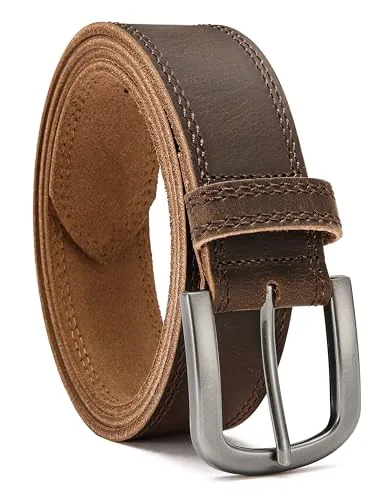
gunmetal buckle
4.5 out of 5 · 2,549 ratings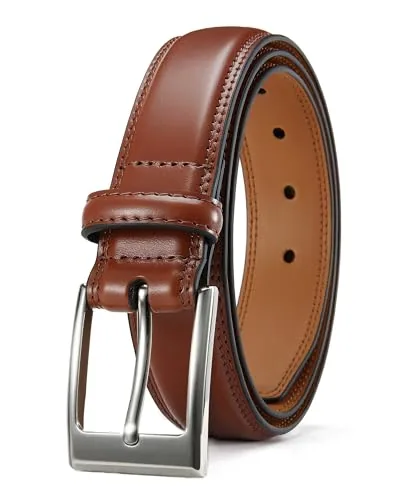
leather
4.4 out of 5 · 4,320 ratings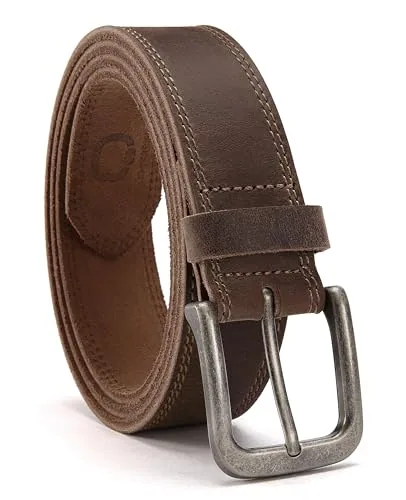
gunmetal buckle
4.4 out of 5 · 1,677 ratingsKeep reading
Two inches, one buckle, and the commonest reason a belt arrives too short.
1,535 words
A belt a child cannot work alone is a belt that lives in a drawer. That is a design question, not a discipline one.
1,613 words